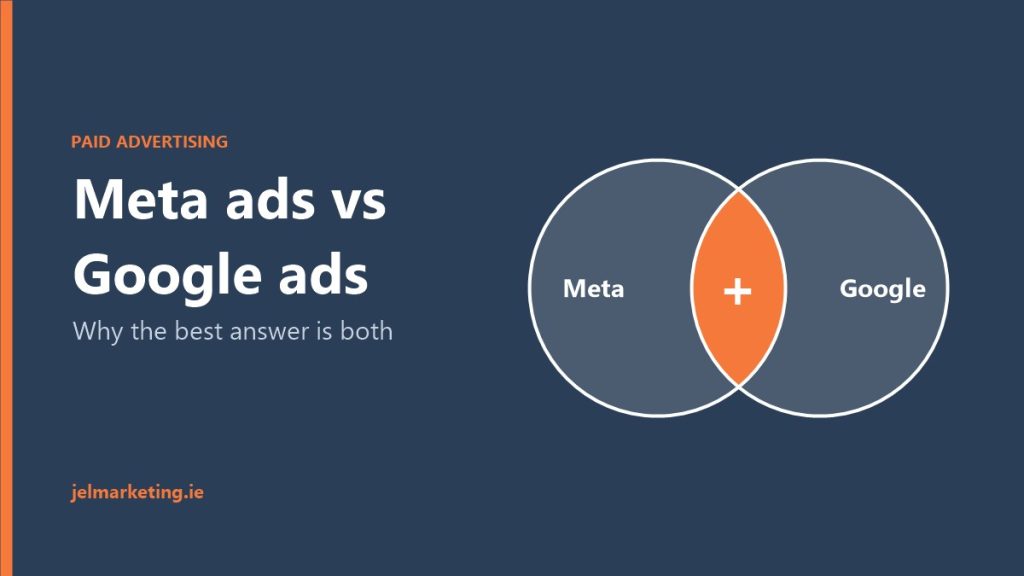

It’s one of the questions we’re asked most often. You have a marketing budget, you want more enquiries or sales, and you need to decide where the money goes. Should it be Meta ads on Facebook and Instagram, or Google ads on search and YouTube?
Our answer is almost always the same. It isn’t one or the other. The businesses that get the best return use both, with each platform doing the job it does best.
How Meta and Google ads differ
The two platforms reach people at different moments, and that is the key to using them well.
Google ads capture demand
When someone searches for “plumber in Galway” or “wedding venue Connemara”, they already know what they want. Google ads put you in front of them at that exact moment. The intent is high, the leads are often ready to buy, and you only pay when someone clicks.
The limit is that Google can only reach people who are already searching. If nobody knows your product exists, there is nothing for them to search for.
Meta ads create demand
On Facebook and Instagram, people aren’t looking for you. They’re scrolling. Meta ads reach them before they start searching, using who they are, where they live and what they’re interested in. That makes Meta ideal for building awareness, launching something new, promoting an event, or reaching a local audience with eye-catching video and images.
The trade-off is that people on Meta are less ready to act straight away, so the creative and the offer have to work harder.
Why a hybrid approach works better
Run separately, each platform does a decent job. Run together, they feed each other.
Meta builds the audience that Google converts
Someone sees your Instagram ad on Tuesday, doesn’t click, but remembers your name. On Friday they search for you on Google, and your search ad is the first thing they see. Meta started that sale and Google finished it. If you only ran one platform, you would either miss the introduction or miss the close.
Retargeting follows people across both
Most people don’t enquire on their first visit to a website. With both platforms running, you can follow up with visitors on Facebook, Instagram, YouTube and across Google’s display network, reminding them why they came and bringing them back when they’re ready.
Each platform makes the other smarter
Meta is a fast, affordable place to test which images, videos and messages people respond to. Google’s search terms show you exactly what your customers type when they’re ready to buy. Feed what you learn on one into the other and both campaigns improve.
How to split your budget
There is no single right split, but the starting point depends on how people look for what you sell.
If people already search for your service
Trades, professional services, healthcare and many local businesses have steady search demand. Lean towards Google to capture those ready-to-buy searches, and use Meta to stay visible in your area and retarget website visitors.
If you’re launching something or selling an experience
New products, events, fundraisers, hospitality and e-commerce often need demand created before it can be captured. Lean towards Meta to build reach and excitement, and use Google to catch the searches your Meta ads generate, including people searching for your name.
Whatever the starting split, review it every month and move budget towards whichever platform is delivering enquiries or sales at the lowest cost.
What makes a hybrid campaign work
Running ads on two platforms is easy. Getting them to work together takes a little more planning.
- Tracking on both platforms, so every enquiry or sale is counted in Google Analytics and reported back to Meta and Google
- Landing pages built to convert, with a clear call to action and a short form
- A consistent message, so the ad someone sees on Instagram matches the one they see on Google
- Results judged on cost per lead or sale, not on clicks or likes
Your website matters as much as the ads. Sending paid traffic to a slow page with no clear next step wastes budget on both platforms. That’s why we build lead generation websites and campaign landing pages alongside the ads we run.
The bottom line
Google ads catch the people who are already looking. Meta ads reach the people who will be looking soon. Used together, with one tracking setup and a website built to convert, they bring in more leads than either platform on its own.
At JEL Marketing we plan, run and report on Meta and Google campaigns for businesses and organisations across Ireland. If you’d like to talk through the right mix for your business, find out more about our paid advertising or request a callback below.